 , (1)
, (1)Auroral luminosity and plasma precipitation at nightside sector
Y.I. Feldstein (IZMIRAN, 142092 Troitsk, Moscow Region, Russia)
Joint PGI and IZMIRAN researches in 60-es covered the region with discrete aurorae dynamics. These results were the basis for suggested in 70-es by SRI and IZMIRAN scientists the scheme of interrelationship between auroral phenomena and night magnetosphere plasma domains structure. The scheme substantially varied from traditionally used then notions on CPS-BPS and auroral oval connection not with the whole tail plasma sheet, but with its boundary layer only. Our scheme was developed further using experimental data available recently. Statements of Yahnin et al. (Ann. Geophys. 1997) paper on substantial differences between our scheme and offered in the above mentioned paper is either misunderstanding or incorrect citation of our results.
Energetic particle drifts in the multifactor model of the magnetosphere
E.Yu. Feshchenko (St-Petersburg State University, Russia, feshch@geo.niif.spbu.ru)
Yu.P. Maltsev, A.A. Ostapenko (Polar Geophysical Institute, Apatity 184200, Russia)
The drift trajectories of the particles with different pitch angles are calculated for the empirical model of the magnetic field by Ostapenko and Maltsev [J.Geophys.Res., 1997, 102, 17467]. The model depends on Dst and Kp indices as well as on IMF Bz, solar wind dynamic pressure, and tilt of the earth dipole. The particle trajectories are computed for quiet and disturbed conditions. Splitting of drift shells seen at distances >5 Re appears to be affected mainly by the solar wind pressure.
Замечание к статье Е.Е.Антоновой, Н.Ю.Ганюшкиной и И.Л.Овчинникова “The magnetostatic equilibrium in the magnetosphere and substorm plasma properties” [Proc. of the 19th Apatity Seminar “Physics of Auroral Phenomena”, Apatity, 1996, pp. 7-10]
Ю.П.Мальцев (Полярный геофизический институт)
Процесс генерации электрических токов
j в магнитосфере описывается обычно с помощью уравнения:[j
ґ B] = r dv/dt - h D v + С p , (1)где В - магнитное поле,
r - плотность плазмы, v – скорость, h - коэффициент эффективной вязкости, р – давление. В модели Данжи преобладающим членом в правой части уравнения (1) считается r dv/dt, в модели Эксфорда-Хайнса -h D v. Справедливость модели Данжи подтверждается четкой связью магнитосферной конвекции (а следовательно, и токов) с южной компонентой ММП. В пользу механизма Эксфорда-Хайнса свидетельствует сильно вытянутый хвост магнитосферы. В работе Е.Е.Антоновой и др. предполагается что за конвекцию и токи ответственен гипотетический градиент давления (третий член в правой части (1)). Экспериментального подтверждения предлагаемого механизма автора не приводят. В своем ответе на замечание рецензента (стр. 117) авторы фактически уклоняются от ответа на вопрос, откуда черпается энергия для поддержания постоянно существующей конвекции. Необходимый градиент давления в течение нескольких минут будет разрушен перестановочной неустойчивостью. Эта неустойчивость является аналогом неустойчивости Релея-Тейлора в обычной гидродинамике ( тяжелая жидкость находится выше легкой ) и застабилизировать ее невозможно.
Замечание к статье Л.Л.Лазутина “Modelling of the auroral electron transport and acceleration during the breakup” [Proc. of the 19th Apatity Seminar “Physics of Auroral Phenomena”, Apatity, 1996, pp. 11-14]
Ю.П. Мальцев (Полярный геофизический институт)
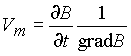
В статье Л.Л.Лазутина утверждается что скорость дрейфа заряженной частицы, помимо известных скоростей электрического дрейфа, дрейфа за счет неоднородности и кривизны магнитного поля, включает в себя скорость так называемого “индуцированного магнитного дрейфа”
, (1)
где В – магнитное поле. Формула (1) ошибочна, поскольку ее применение приводит к нарушению закона сохранения энергии.
Remote sensing of the plasma distribution and current density in the plasma sheet
S.V.Dubyagin, M.V.Kubyshkina, V.A.Sergeev (St-Petersburg State University, Russia)
In the midtail equatorial plasma sheet the proton component of plasma pressure is known to be isotropic due to the particle scattering in the highly-curved magnetic field and, therefore, it can be nearly constant along the magnetic field line. With this hypothesis the remote sensing of plasma sheet parameters from low-altitude precipitated protons measurements becomes possible. We discuss the physical conditions to realise this procedure, the algorithm of pressure derivation and how to select the proper domain where the isotropic approximation should be valid. Since the plasma sheet current primarily depends on the pressure gradient, the isotropic pressure condition provides a possibility to evaluate the tail current. We present the quantitative estimates of pressure and current density in the equatorial tail on the field lines corresponding to the electron isotropic boundary and compare these values with independent estimates of these parameters. We also study the spatial distribution of plasma pressure in the equatorial plane for the steady convection event on 24 November 1981 by using the magnetic field model constructed previously for that event.
Formation and Stability of the Magnetotail Plasma Sheet
E.V. Voronov (Institute of Solar-Terrestrial Physics, P. O. Box 4026, Irkutsk-33, 664033, Russia)
I.A. Krinberg (Irkutsk State University, 20 Gagarin blvd., Irkutsk, 664000, Russia)
We investigate the possibility of formation and maintenance of plasma sheet-like magnetic field by the particles of the plasma sheet itself, whose population originates from the magnetotail lobe cold plasma (both of ionospheric and solar origin). A 1-d approximation is used, i.e. all parameters depend on GSM Z only, the magnetic and electric fields are considered as B = (Bx(z), 0, Bz) and E = (0, Ey, Ez(z)) respectively. Here the Bz and Ey components are considered to be formed by external sources, but the Bx(z) and Ez(z) are self-consistent fields. Self-consistent solutions were obtained on the basis of hybrid simulation, i.e. the ion phase coordinates are integrated from the equations of motion with Lorenz force, whereas the electrons are treated as a massless fluid that provides the quasi-neutrality.
The main results of the simulation are:
1) Under Bz=0 the Harris-like plasma configuration remains steady for at least some hundred seconds.
2) The appearance of even small Bz leads this plasma sheet to become unstable, even under Ey>0.
3) If the magnetic tubes are initially uniformly filled with maxwellian plasma, the magnetic configuration is also unstable under Bz>0 and Ey=0.
4) The appearance of Ey leads to plasma drift toward the neutral plane and to ion acceleration. If the ion motion in the neutral sheet with small Bz is non-adiabatic and the drift velocity of the magnetic line top UExB exceeds significantly the thermal velocity of ions in the lobe, a very thin (a few hundred kilometres) steady current sheet forms in the vicinity of the neutral plane. In this region the plasma density and temperature are sharply enhanced in respect to a lobe region.
We discuss the features of the self-consistent plasma and field configuration, including the particle distribution functions and the possibility to interpret it as a collisionless shock wave of compression.
Acknowledgement. This work was supported by the Russian Foundation for Basic Research via grant 96-05-64478.
The interball-2 electric potential and plasma density
K. Torkar (Space Research Institute, Austrian Academy of Sciences, Inffeldgasse 12, A-8010 Graz, Austria)
M.V. Veselov, Yu.I. Galperin, V.V. Afonin, M.M. Mogilevsky (Space Research Institute, Russian Academy of Sciences, 117810, Profsojuznaya st. 84/32, Moscow, Russia)
S. Perraut (CETP/UVSQ, Velizy, France)
The results on the S/C electric potential in respect to plasma from the INTERBALL--2 satellite (Auroral Probe) are presented and analysed together with the data on thermal plasma. The data indicate relatively low S/C potentials till the apogee (~19000 km) and are shown to be consistent with the model. The applicability of S/C potential measurements for electron density estimation for “Auroral Probe” was analysed. The preliminary results show a good agreement with a Pedersen’s empirical equation. Derived electron density profiles for selected orbits are demonstrated.
Interchange instability development of magnetosphere - ionosphere convection
M.A. Volkov (MSTU), R.Yu. Yurik (PGI KSC RAS, MSTU)
The outer and inner boundaries of the plasma sheet can be unstable [1, 3]. The papers [2, 3] show, that magnetosphere - ionosphere convection causes interchange instability on the inner boundary of the plasma sheet. As a result, electric field and field-aligned current structures are formed. They stretch approximately along east-west direction. This instability allows us to explain generation of discrete auroral forms. In this paper an interchange instability development of the plasma sheet is studied. In contrast with papers [2, 3], here it is assumed that the magnetic tubes move with hot magnetospheric ion velocities. In this case, the conditions of instability development depend on mutual direction of gradients of background plasma pressure and the magnetic field and on gradients of charged particle background density in the magnetosphere as well. The growth rate of the instability is appropriated for different regions of the magnetosphere.
1. Swift, D.W., The possible relationship between the auroral breakup and the interchange instability of the ring current, //Planet. Space Sci., v.15, 1225-1237, 1967.
2. Volkov, M.A., Yu.P. Maltsev, Interchange instability of the inner plasma sheet boundary, //Geomagn. Aeron., 26, 798-801, (in Russian), 1986.
3. Kozlovsky, A.E., W.B. Lyatsky, Instability of the magnetosphere-ionosphere convection and formation of auroral arcs, //Ann. Geophysicae, 12, 636-641, 1994.
Accelerated electron beam precipitations in and around the cusp/cleft region
W. Lyatsky, M. Goncharova, V. Kriviliov (Polar Geophysical Institute, Apatity, Russia)
D. Sibeck (APL/JHU, Laurel, Maryland, USA)
From the DMSP satellite measurements for several months, 1984, discrete accelerated electron beam precipitations in the cusp/cleft region are investigated. These events are observed not for the negative IMF Bz values only, but for positive Bz (by small By) values as well, i.e., when the magnetic reconnection on the lobe magnetic field lines is expected. These auroral electron precipitations (associated perhaps with the PMAFs) appear immediately posterior to the equatorial boundary of the LLBL or even that of the BPS (as was pointed out earlier by Newell et al., 1991). They are often embedded in the diffuse background dayside PS or BPS electron precipitations. The spike structure in the electron precipitations being observed together with the plasmasheet electron population indicates that some part of the dayside auroras may appear on closed field lines. Very important result is that the polar boundary of plasmasheet plasma population shows the energy drop which is not sharp as expected for the magnetic field reconnection but smooth within a finite latitude range. Perhaps this plasma remains on closed but increasing-in-length magnetic field lines. Sometimes such smooth energy transition in fractions of PS-like electron population down to energies typical for cusp is observed to repeat along the satellite trajectory, being distanced rather far in latitude that is also hard to explain in terms of reconnection. A possible explanation is the most equatorial of the events may be placed on closed magnetic field lines, and may be formed due to some another mechanism than burst-like reconnection at the dayside magnetopause.
Dayside high-latitude auroral pulsations and magnetospheric region of their generation
V. Vorobjev, O. Yagodkina (Polar Geophysical Institute, Apatity, Russia)
Dayside auroral pulsations (APs) have been investigated on the basis of optical observations from high latitude Barentzburg and Heiss stations for nine winter seasons from 1981-1990. Simultaneous ground-based and satellite (DMSP, NOAA, IMP-8) measurements were used for study of morphological features of APs, and particle precipitation structure as well as interplanetary medium parameters. It is shown that APs registered as quasi-periodical (10-40 s) increases in the 557.7 nm emission intensity are predominately occurred from 08-11 MLT during rather quiet geomagnetic conditions. Pulsations are caused by the 4-6 keV average energy electron precipitation from the magnetospheric region, which maps to the poleward edge of the central plasma sheet (CPS), and equatorward the high-latitude trapping boundary of energetic electrons (E>30 kev). We determined the CPS from DMSP satellite data as a wide region of unstructured E>1 keV electron precipitations that were registered equatorward dayside soft electron precipitation zone. Large cone angle of the IMF for auroral pulsation times allows to exclude the solar wind region before the bow shock (the foreshock) as a source for generation of the auroral pulsations. We consider that instability at the outward edge of the radiation belt may be the most probable source of an APs generation.
Enhancements of energetic proton fluxes at subauroral latitudes, their relation to plasmapause and ion-cyclotron waves
T.A. Yahnina, E.E. Titova, A.G. Yahnin (Polar Geophysical Institute, Apatity, Russia)
There are different types of energetic (>30 keV) proton precipitation at latitudes near plasmapause. Using the data obtained onboard the low-altitude NOAA satellites we performed a morphological study of specific energetic proton flux enhancements, which looks like isolated proton flux bursts within a narrow latitudinal extent (1-2 degrees). The flux of locally trapped protons may increase for 1-2 orders of value at this extent. The phenomenon is observed mainly during recovery phase of magnetic storm when geomagnetic activity is rather low (AE<200 nT) and may exist as long as several hours. The proton flux enhancements can be observed simultaneously in different sectors of MLT approximately at the same latitude. They are detected at Inv.Lat.= 55-67O with maximum of occurrence at 60-62O. Most of the proton bursts (93%) are strongly anisotropic, that is they are seen only in locally trapped particles. The bursts containing also precipitating particles are observed mainly on the day side. In addition to morphological investigation, we compared the proton enhancement observations on NOAA satellites with simultaneous measurements of ion-cyclotron waves and electron density and temperature onboard the DE-2 satellite. Energetic proton bursts spatially coincide with the local maximum of plasmaspheric electron temperature usually situated inside of the plasmapause as well as with spikes of ion-cyclotron waves.
Dayside Pi2 current system research on the base of nearly placed subauroral component magnetic stations' data analysis
A.V. Petlenko (SPbF IZMIRAN, P.O. Box 188, St.-Petersburg, 191023, Russia)
Excitation of dayside Pi2 pulsations on the recovery phase of magnetic substorm in the period 18.58-19.08 97.10.01 is considered on the base of data analysis being applied to the data of 50km longitudinally distanced subauroral component magnetic stations (LEH (64.25.39N, 33.58.25E) and VIR (64.20.12N, 35.11.12E)).
During that period two disturbances 1,2 in magnetic field Z-component were obtained with delay 8min, amplitudes 3nT, 8nT and durations 4min, 10 min respectively. Both 1 and 2 appeared in LEH with a visible lag 10s to VIR's Y and Z components and were almost simultaneously in X one.
Data processing according [1] has shown that 1) pulsations being associated with 1 are irregular ones, whereas those with 2 are of the Pc type; 2) during 1 one can see at least two impulse bursts of irregular pulsations following with a rate 100s of Pi2 period in auroral zone; 3)during 2 two packets of stationary Pc4 range pulsations were observed; 4)group appearance times for all pulsations mentioned for LEH are equal to those for VIR; 5)components of pulsations in both LEH and VIR were different by amplitude and by phase; polarizations changed their rotation from contra-clockwise to clockwise during the pause between 1 and 2; 6)during period appointed contiguous component's differences between LEH and VIR achieved their maxima.
These results allow to characterize the source of dayside Pi2 in terms of 3D current system, the upward currents are likely responded for 1, downward ones for 2. Footprints of both Birkeland currents were located at the north-east of LEH (nearer to VIR). Phase velocity of disturbances was evaluated as 3km/s.
Resuming we can conclude that our results are seems to support i) an idea of similarity of Pi2 current system in dayside magnetosphere to the nightside current wedge [2]; ii) conception of upward current oscillation's efficient role in the processes of Pi2 generation in dayside as well as in midnight sector.
[1] Petlenko A.V.,Geom. and Aeronomy, v.34,1994,p.72-79
[2] Raspopov O.M.,Geom. and Aeronomy, v.30,1990,p.608-611
[3] Petlenko A.V.,Raspopov O.M.,Shumilov O.N.,Geom.and Aeronomy,1997(press)
Concerning non-conjugation of magnetic impulse events in the dayside high-latitude ionosphere: model study
L. Benkevich, A. Kozlovsky, W. Lyatsky (Polar Geophysical Institute, Apatity, 184200, Russia)
An approach to calculating three-dimensional current systems has been developed, allowing for significant difference in the ionospheric conductivity between the northern and southern hemispheres. Such difference is brought about by both seasonal and diurnal changes. The approach has been implemented in a numeric model, which is applicable for evaluating equivalent ionospheric currents and thereby ground-observed magnetic effects. The equivalent current systems in either hemisphere have substantially different patterns. Such non-conjugation is a consequence of secondary field-aligned currents emerging on the boundary of the ionospheric conductivity discontinuity, the currents flowing between the conjugate hemispheres. The results obtained are applied to the phenomena like the magnetic impulse events and the travelling convection vortices in the high-latitude ionosphere.
Hyperboloid instrument observations above different magnetospheric zones
D. Chugunin(1), N. Dubouloz(2), Y. Galperin(1), J.-J. Berthelier(2), M. Malingre(2), T. Mularchik(1)
(1) Space Research Institute, Russian Academy of Science, Profsouznaya St., 84/32, GSP-7; Moscow 117810, Russia
(2) Centre d'Etude des Environnements Terrestre et Planetaires, Centre National de la Recherche Scientifique, 4 avenue de Neptune, 94107 Saint-Maur Cedex, France
The energy-mass-angle spectrometer Hyperboloid measures thermal and superthermal ions H+, He+, O++ and O+ in energy range 1-80 eV. The analysis of distribution functions of these ions is presented in the different magnetospheric zones (polar cap, polar diffuse aurora, auroral oval of discrete forms, equatorial diffuse aurora and plasmasphere). The boundaries of these zones were determined from analysis of simultaneous hot electron measurements.
Energetic upward electron beams above the high-latitude polar cap
V.A. Stepanov, Yu.I. Galperin, F.K. Shuiskaya, A.K. Kuzmin, R.A. Kovrazhkin
(Space Plasma Physics Department of IKI RAS, 84/32 Profsoyuznaya Str, Moscow, 117810, Russia)
Several cases of upward high-energy (20-45 keV) electron beam observations at altitudes about 3 Re are presented. Observed high-energy beams are accompanied by bi-directional low-energy (1 keV) electron beams. The ILAT-MLT location of the beams in the postmidnight-to-morning sectors is consistent with the Region I downward field-aligned current, although not proved by direct magnetic field measurements. A qualitative scenario of the acceleration mechanism is proposed, according to which the satellite is supposed to be within the bi-directional acceleration region where a stochastic FA acceleration occurs due to interactions with waves with FA electric field components fluctuating in both directions along the magnetic field line. Some wave-particle interaction mechanisms are considered at the first glance as possible candidates for the acceleration scenario. Evidence exists that the acceleration region is extended up to 6 Re. Some interesting speculation about possible role of the electron beam in destabilizing the stability conditions of the magnetotail current sheet is also considered.